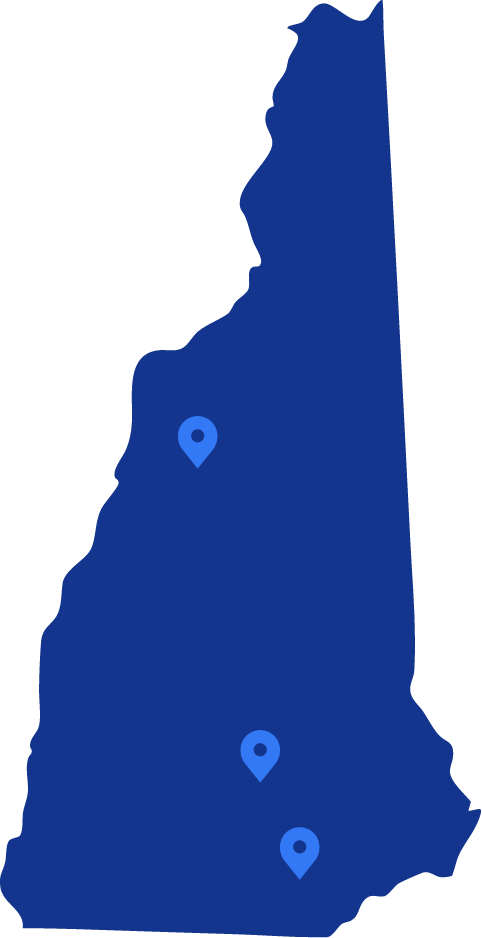



BARTLETT – Facing closure under the Trump Administration, more than 50 forest experts and supporters of the Bartlett Experimental Forest met here with Congresswoman Maggie Goodlander, D-NH, on Monday to begin to work on a plan to save it and all the information developed over almost 100 years.
While Democratic U.S. Senators Jeanne Shaheen and Maggie Hassan, along with Republican Gov. Kelly Ayotte announced several weeks ago they were able to reverse a proposal to close the Hubbard Brook Experimental Forest in Thornton and Woodstock, this other experimental forest on the other side of the White Mountains is still imperiled.
While the bipartisan delegation said they were successful in asking the federal government to keep Hubbard Brook open, they got the government to agree to revisit the closure at Bartlett.
Hubbard Brook does world class ecosystem bio/geo chemistry work and Bartlett does applied forest research.
After a field trip with Goodlander and her staff into the experimental forest to look at clear cuts and various soil types and learned about silvicultural experiments since 1932, they sat down with the first-term congresswoman who learned there simply isn’t the staffing to support the historic work right now, which is part of the 800,000-acre White Mountain National Forest.
After the meeting, Goodlander said “just to be here with people who are in the forest industry, every stage of the supply chain, to hear from people who have been working in this forest since 1958, it’s incredible. You just can’t recreate this. As I was saying, it is hard from a distance to imagine how anyone would be orchestrating and executing a reorganization plan without actually coming here and talking to the people… You’ve got to see it. You’ve got to understand the relationships that are complex.
“…in the case of Bartlett, we are going to have to be creative, but also relentless. Because you just can’t allow these forests, which can’t be recreated, to be put on the chopping block,” Goodlander said.
“We have the Farm Bill and we have had a number of amendments that have gone to try to protect experimental forests – and there are several dozen across the country – obviously the two in New Hampshire are huge assets for the northeast, but we’ve got the Farm Bill, we’ve got the appropriations process that is coming up and a lot of questions raised today about where federal funding that has been promised to our experimental forests actually is right now, which has been a reoccurring question the last year and half.
“One of my big takeaways is being quiet does not help anyone in New Hampshire. We’ve got to be really clear about what’s not happening and where we want things to go,” Goodlander said.
The Bartlett Experimental Forest is located in the Saco Ranger District of the White Mountain National Forest. Much of it is along the side of Bear Notch Road and is administered by the Northern Research Station in Durham.
This is part of a large network of forest and rangelands scattered across the United States. These sites were established to conduct long term research on the major vegetation types across the 195 million acres of public lands administered by the U.S. Forest Service,” a welcome sign off the Bear Notch Road states.
The original 2,600-acre footprint was established in 1932 to study northern hardwood silviculture (the art and science of growing healthy quality forests). In 2005 the Bartlett forest was expanded to 5,789 acres to include the upper elevations of the Bartlett watershed.
Upper elevations were left in an unmanaged condition to provide control areas to compare results of experimental areas where clearcuts or prescribed fires have been done to see impacts.
Research over the last 30 years has also included habitat for amphibians, small mammals, song birds and bats “and has become increasingly important as a site for studies on carbon and nutrient cycling.”
Silvicultural threats, including invasive pests, have been studied to inform landowners on action to be taken to protect value and assets.
Anthea Lavallee, executive director of the Hubbard Brook Foundation, said the science is still really important today, particularly as new wood products are coming to the market with new manufacturing technology.
“These new markets and supply chains as we build them stronger will revitalize our northern forest economy. Knowing how the forest is changing…is going to be essential for managing new wood products sustainably into the future,” Lavallee said.
Steve Fay, who for 25 years was a forest soil scientist on the WMNF at both Hubbard and Bartlett experimental forest said one of the most striking changes across both managed and unmanaged plots is a steep decline in shade intolerant aspen and paper birch over the 85 years of study.
In contrast, he said eastern hemlock has increased from about 8 percent of 25 percent in basal area on the managed plots and from about 10 percent to 30 percent on the unmanaged plots.
“The fact these changes have happened on both the managed and unmanaged areas tell us there is more going on that a reallocation of growing space following partial harvests on the managed lands…the data continue to show little or no evidence of upward migration of species (Leak Transect), despite evidence of regional change in climate,” he said.
Tony Federer who began work at the Bartlett Experimental Forest in 1958 suggested that there needs to be more forest service administration linking the various aspects from forestry to science and more collaborative efforts.
And others said some of the 15 buildings from the Civilian Conservation Corps era which are part of the forest, might not need to be kept to keep it going but a core building for science labs and meetings is necessary.
Lavallee, of Hubbard Brook, said she would love a collaborative effort between the two forests and that is actually what has come of this situation.
“We have worked more closely together now than we have in the past and that is one of the silver linings of this crisis is that it has really galvanized the community around what we stand to lose and how we are so much stronger together. I would love to imagine how we might be able to coordinate more going forward so that…we can have more coordinated science together and be a more resilient team and alliance,” she said.